

In the modern world that is fast-paced, learning is not restricted by classrooms or formal school learning. You can be a student or a working professional or simply a person who wants to become better, the daily learning habits (Daily Knowledge Improvement Habits) can make you keep abreast with time and feel confident. Perceiving and memorizing things quicker with easy skill may offer you an invincible edge in the personal and professional spheres.
Nevertheless, consistency is an issue with many people. They read at times, watch educative videos periodically or attempt to acquire new skills without having a clear plan. The result? Stunted development and disappointment. The fact is that you do not need to spend many hours or elaborate plans to get your knowledge better every day. What it requires is a quick yet organized strategy supported by effective habits.
This is a list of 7 practical and easy habits that could assist you in learning faster, retaining more and developing a solid base of knowledge in the long run. These techniques are grounded in a practical psychology, real-life application, and effective learning techniques- so that you may begin to get some results right away.

It is noteworthy to know why consistency is better than intensity before immersing oneself in the habits.
Studying an hour per week is a lot less efficient than 10-20 minutes of learning every day. Daily habits:
- Enhance the memory by rehearsing
- Be more disciplined and focused
- Develop long term knowledge
- Eliminate pre-test anxiety or pre-exam tension
- Assistance in keeping up with your profession
The process of learning is like exercise. The daily minute efforts produce effective long term outcomes.
Wake Up and Intentionally Learn

Learn to Make Mornings Count
Among the most appropriate learning habits are the ones that allow you to have the first 15-30 minutes of your day in a meaningful way by acquiring something of use.
The brain is fresh in the mornings and it is easy to receive and assimilate new things.
How to Apply This Habit
- Read 5-10 pages of a useful book
- YouTube: You are a Good Person, The Foundation of Happiness
- Recap of the notes written the day before
- Gain some new knowledge in your discipline
Real-Life Example
As a government employee who has been preparing to pass promotion exams, every morning I go through one topic a day. They go through the entire syllabus without stress within 3 months.
Apply the Learn and Teach Method
Reasons Boosts Learning by Teaching
Teaching is one of the quickest methods of learning. Your brain puts the information in a more organized manner when you explain something.
This can be referred to as the Feynman Technique.
How to Apply
- Once you study a subject, be able to describe it using basic words
- Educate a friend, brother or sister or co-worker
- Write a brief short summary as though it were being taught to someone who has just started out
Practical Tip
When you are able to define something in a simple way, then you really know its meaning.
Go Beyond Macro-Learning to Micro-Learning
Learn in Small Chunks
Attempting to study things simultaneously will result in a lack of understanding and ineffective memory. Rather, make your learning small, in small chunks.
How to Apply This Habit
- Study one topic at a time
- Pre-establish a 20 minutes learning period
- Have breaks in between sessions
Example
Reading does not mean learning a whole chapter, but:
- One concept
- One definition
- One practical application
This enhances a faster and effective learning process.
Active Recall and Spaced Repetition
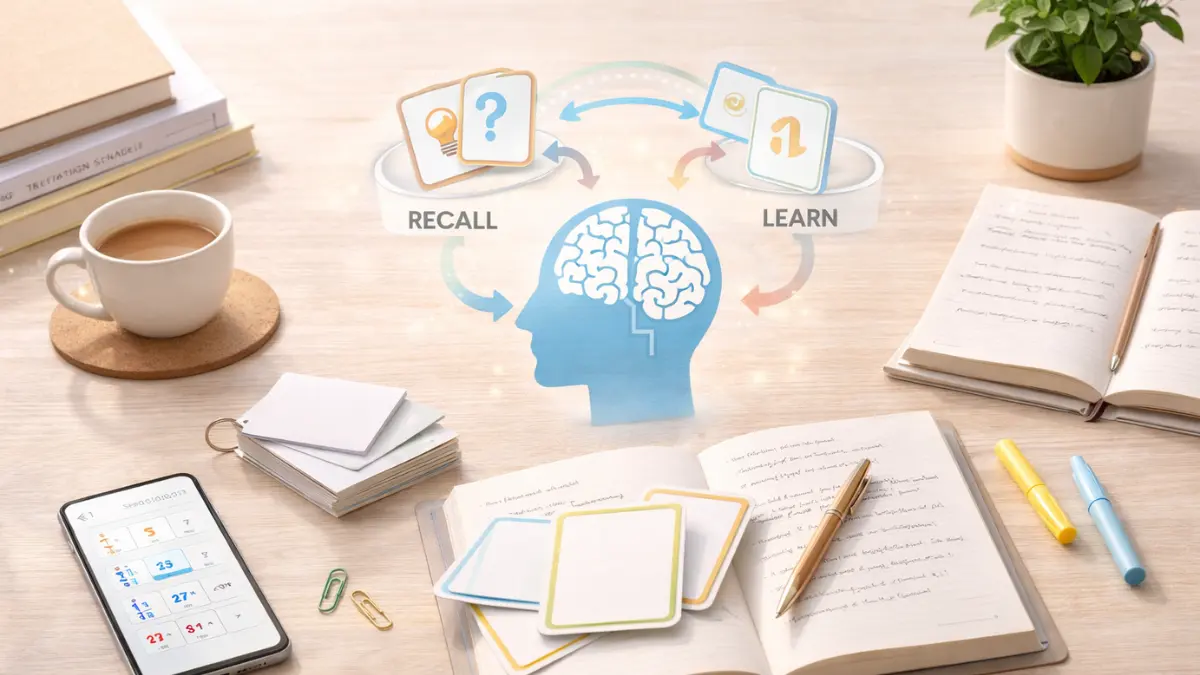
What is Active Recall
Active recall refers to self-testing rather than reading or underlining.
What is Spaced Repetition
It is a process that entails the revisiting of information with an ever-growing time interval in order to enhance memory.
How to Apply
- Shut up your book and remember what thou hast learned
- Use flashcards
- Review at 1 day, 3 days and 7 days
Why It Works
The approach enhances memory channels, as well as lessens forgetting.
Eliminate Distractions and Provide a Learning Environment
Focus is the New Superpower
It is impossible to develop knowledge in a distracted setting.
How to Apply
- Turn off notifications
- Study in a quiet place
- Pomodoro technique Use a timer
- Only essential items should be kept around
Real-Life Insight
Students who take hours of learning still get little as a result of distractions. It is more efficient to learn with a focus of 30 mins rather than 2 hours of interrupted learning.
Put into Practice What You Study
Without Action No Knowledge Is Good
The last and one of the least noticed but significant things that one should do is apply what they are learning in practice.
How to Apply
- Practice problems
- Apply new knowledge in practice
- Write articles or notes
- Discuss ideas with others
Example
In case you learn communication skills, you should start practicing them in the workplace right at the same day.
This creates trust and profound knowledge.
Monitor Your Day to Day Learning
Measure What You Learn
Keeping a track of your progress also helps you to be motivated and consistent.
How to Apply
- Maintain a learning journal
- Write 3 things that you learned every day
- Set weekly goals
- Assess how you are doing on Sundays
Benefit
Your improvement is evident and this gives you motivation.
More Daily Learning Habits
- Read quality articles as opposed to random material
- Listen to educative podcasts
- Follow reliable sources
- Be interested and posing questions
The Advantages of a Daily Learning Habit
Faster Learning Speed
You learn things fast and productively.
Better Memory Retention
Things remain longer in your brains.
Increased Confidence
The knowledge strengthens the confidence in the self when it comes to discussions and making decisions.
Career Growth
Never ending learning will make you a competitive person in your area.
Better Problem-Solving Proficiency
You are able to think over and problem solve better.
Common Mistakes to Avoid
- Inconsistency – Studying not on a daily basis
- Passive Learning – Nothing more than reading or watching
- Multitasking – Attempting to learn more than one thing at the same time
- Lack of Revision – Failing to go through learnt material
- Unrealistic Goals – Goal targets that are too challenging to sustain
Some of the Tips That Allow One to Learn Faster Are Given by Experts
- Pay attention, not learning by heart
- Learn to use simple terms in explaining things
- Be inquisitive and ask questions such as why
- Avoid information overload
- Maintain a balanced routine
Most Popular Questions Frequently Asked Questions FAQ
What should the duration be of study per day in order to enhance knowledge
Even 20-30 minutes of concentrated daily studies suffices in case it is carried out regularly.
When is it the most appropriate to learn
Any regular time is perfect, however, in the morning is the best.
Would I be able to be more knowledgeable without books
Yes. Videos, podcasts, and experience can be used.
How can I stay consistent
You need to start small, make achievable goals and know your progress on a daily basis.
What is the time frame to achieve results
And you can see that you are improving after 2-3 weeks of practice.
Conclusion
One of the most productive investments that you can make on yourself is developing habits of learning every day. Simply consistency, concentration, and the proper attitude are all you need since you do not need costly courses or hours of study.
With these 7 tips you can start your day by learning, then teaching others, micro-learning, recall, distractions, applying the knowledge, and tracking the progress you are making and you will see a significant improvement in your capacity to learn much faster and certainly retain what you have learned.
It is not the amount of things in learning where one succeeds but it is rather the quantity of doing the correct things. Begin with a little, be determined and you would be learning something new on a daily basis.