

It is not only about memorizing books or beating exams on the one hand, learning is a life process that not only influences your way of thinking or problems-solving but also makes a person more mature. The difficulty encountered by many students is that they use the old and ineffective methods of studying without knowing how the brain learns. There is where Interesting Learning Facts for Students can be interesting.
As soon as you know how your brain functions, how memory enhances, and what techniques, in fact, positively influence the learning process, it will be more convenient, quicker, and even fun to learn. Such facts are not merely a theory but they are supported by the real-life experiences and practical observations, as well as, by educational insights that are proved.
This paper will reveal to you 8 incredible and potent learning facts that can totally revolutionize your study. You are either about to be tested, enhancing yourself, or just trying to be smarter, all these tips will make you achieve what you are capable of.
Your Brain Learns Better in Short Sessions (Not Long-Time Sessions) – Interesting Learning Facts for Students

Educators who provide children with short sessions (not long-time sessions) find it easier to sustain their brain activity and learning processes.
Among other interesting learning facts relevant to the students is the fact that long study sessions are not effective as compared to short and focused sessions.
Why This Works
Your brain cannot give you much attention. The concentration begins to decline after the 2540 minutes and the amount of information retained becomes lower.
Real-Life Example
Students that study without taking a break of 6 hours are likely to forget majority of what they read. However, the ones who study in 25 minutes focus sessions with brief intervals recall more.
Actionable Strategy
Follow the Pomodoro Technique:
- Study for 25 minutes
- Have a five minutes break
- Do four times, and have a more extended pause
This is a better way of enhancing concentration, lessening exhaustion and enhancing output.
2 The Teaching Other People Makes You Learn Even More
Learning are the techniques to teach someone something.
The two facts of learning are powerful and yet very frequently overlooked:
You can only teach something, and you really understand it.
Why This Works
As you expound some concept:
- You have a clear way of organizing information by your brain
- You realize where you have weak areas in knowledge
- You strengthen the memory by means of repetition
Practical Tip
- Fee: You must present your report on a subject after studying it
- Share it with a friend, a brother or even with oneself
- Use simple language
- Do not make notes as you explain
This method is also referred to as Feynman Technique and it is very effective.
Sleep is a Very Important Part of Learning

A lot of students want to study as much as possible at the cost of sleeping hence this is a wrong thing.
Key Insight
When you are sleeping your brain:
- Processes new information
- Strengthens memory
- Removes unnecessary data
Real-Life Scenario
A student who takes 2 hours of study and takes a good sleep usually performs better as compared to someone who spends 5 hours studying and spends all the night awake.
Actionable Advice
- Sleep 7–8 hours daily
- Studying serious matters before going to sleep should be avoided
- Note down important things in a nutshell before sleeping
This is among the most feasible appealing facts of learning to the students which has a direct influence on performance.
Fourth Writing on Paper Enhances Memory
It is also possible to type notes much quicker but handwriting is more successful in learning.
Why It Works
Writing by hand:
- Engages more processing of the brain
- Improves understanding
- Assistance in the long-term retention
Practical Example
Individual writing of summary has a longer lasting effect on the concepts that students have compared to copy-pasting or typing notes.
Strategy to Apply
- Note-taking on important subjects should be made using notebooks
- Make summaries at the end of the study
- Highlight key points
5 Multitasking Decreases the Learning Efficiency
The majority of students assume that they can study and use the phone or play music with lyrics. This however is a myth.
The Truth
Your brain can not multitask, it is an alternation of activities, which:
- Reduces focus
- Increases mistakes
- Slows learning
Real-Life Observation
The learners studying without distractions take shorter periods of time to accomplish their tasks and remember more.
Actionable Steps
- Turn off notifications
- Do not use your phone in the course of studying
- Work in a peaceful environment
This is among the most influencing learning facts of interest to the students, which can be immediately enhanced to boost productivity.
6 It is Better to Revise Rather Than to Make a First Time Learning
It is not just sufficient to read something once. The secret of mastering is revision.
Why It Matters
Without revision:
Information retention of 70 percent is lost in 24 hours.
Effective Revision Method
Use Spaced Repetition:
- Review after 1 day
- Then after 3 days
- Then after 7 days
Practical Tip
Set a timetable of revision as opposed to learning new subjects on a daily basis.
Active Learning Beats Passive Reading
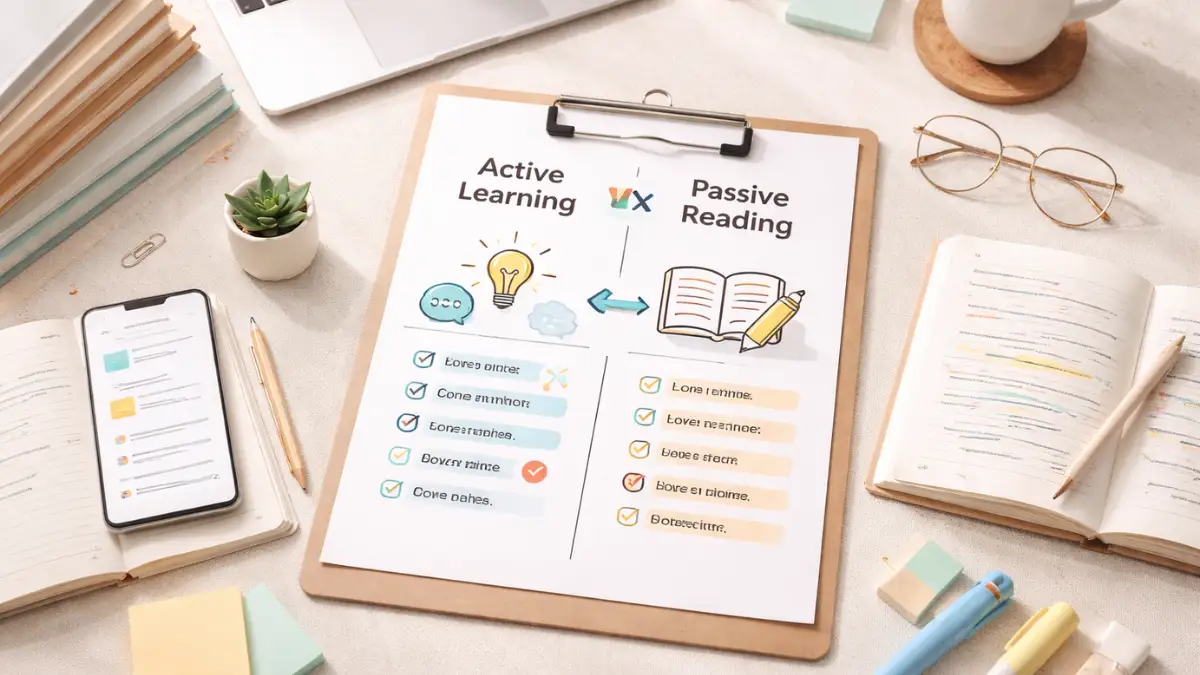
One should not just read a book. Learners should be involved with the material.
Active and Passive Learning
Passive Learning:
- Reading without thinking
- Highlighting everything
- Learners are asked to watch videos without notes
Active Learning:
- Asking questions
- Solving problems
- Writing summaries
- Testing yourself
Real-Life Example
Practicing questions leads to better results in students as compared to reading theory.
Action Plan
- Question answer after every topic
- Make up a quiz of your own
- Be able to explain things using your own words
Your Environment Affects Your Learning Power
The environment is very significant in learning.
Key Factors
- Lighting
- Noise level
- Study space cleanliness
- Comfort
Real-Life Insight
Eaters of study desk is a clean and organized study desk that enhances concentration and lowers stress.
Recommendations to Enhance Environment
- Select an area of study where there is no noise
- Be able to keep your desk clean
- Use proper lighting
- Do not study on bed
It is one of the most fascinating facts of the learning that students have ignored yet it has a great influence on the performance.
The Advantages of Knowing These Facts of Learning
The following interesting learning facts can be applied to the students to bring significant changes:
- Better memory retention
- Faster learning speed
- Improved exam performance
- Fewer stresses and burnouts
- More emphasis and concentration
The Misconceptions That Students Should Not Make
Even the students who work hard commit such mistakes:
- Prolonged and continuous study
- Ignoring sleep
- Not revising regularly
- Multitasking during study
- The dependence on reading (no practice)
- Cramming before exams
These are some of the errors that can be avoided to achieve a significant improvement.
Routine Day to Day Learning Step by Step
This is a basic routine, which is grounded on these learning facts:
Morning
- Learn not easy subjects (fresh mind)
- Apply 25-minute concentration doses
Afternoon
- Practice questions
- Revise previous topics
Evening
- Review notes/ light study
- Educate what you got taught
Night
- To revise fast before going to bed
- Sleep on time
Frequent Ask Questions Interesting Learning Facts to Students
1 What’s the Best Way to Study Properly
Active learning, short learning sessions and frequent revision are the best methods to use.
2 What Number of Hours Do You Think a Student Should Study Daily
It is more about quality rather than quantity. Two to four intensive hours are superior to the long distracted periods.
3 Which Is More Preferable Evening or Morning Study
Morning tends to be a better time to focus and this is according to the individual preference.
4 What Can I Do to Enhance My Memory Within a Brief Period of Time
Spaced repetition, handwriting, and sleep are all good methods of memorizing.
5 What Is the Impact of Phone Use on a Study
Admittedly, it decreases attention and retention.
Conclusion
The knowledge of the working process of learning can be the key to changing the experience of studying entirely. These are not mere theories that students should learn but rather practical proven tips on how to study smarter not harder.
With the help of such strategies as short study sessions, active learning, good sleep, and frequent revision, you can become more focused, have better memory, and better performance in general. It is all about consistency, making little steps every day will result in major outcomes in the long run.
Begin to apply at least some of these methods today and you will find that there is a marked difference in the way that you can readily learn and remember.